In this article
A store career diagram is a map of responsibilities. It is not a timetable, a guarantee of advancement or a complete description of a particular opening.
Read the role before the rung
ALDI’s US store page describes part-time stockers as shelf and store-task contributors, cashiers as checkout and customer-service contributors, and full-time store associates as combining register and stocking work. It also presents lead, assistant manager, trainee and store manager roles. Those distinctions are more useful than assuming every title is the same work with a different badge.
MyALDI USA’s developer listing describes a communication app that includes company news and careers information. A news item may introduce an opportunity; the actual vacancy and authorized hiring conversation establish what is available. This journal uses US sources. It does not transfer a UK job title, an Australian schedule or an ALDI Nord policy into a US role description.
Build a three-column role note
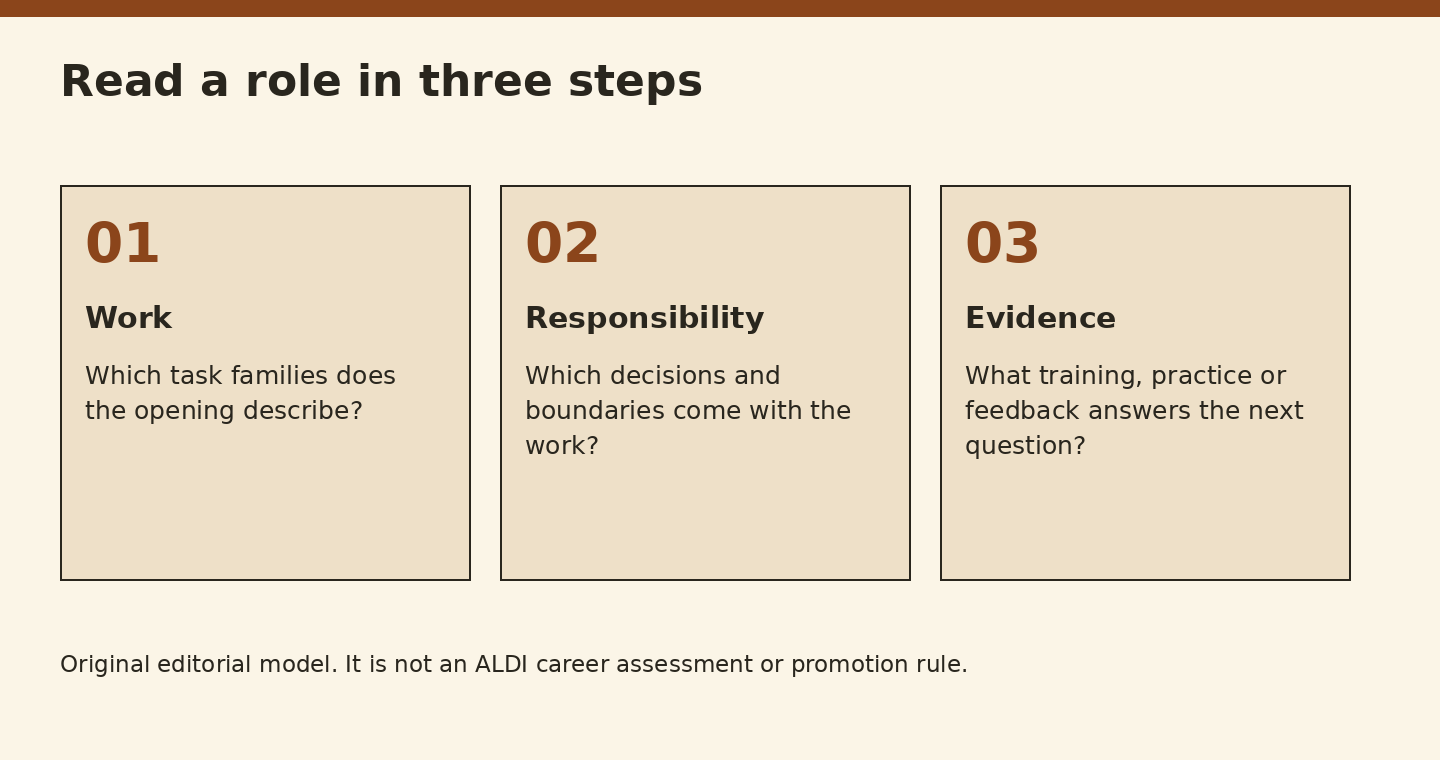
For a role that interests you, record the task, the responsibility attached to it, and the question you still need answered. “Customer service” is a task family. “Who handles an issue that exceeds my authority?” is a responsibility question. “What training happens before independent work?” is an evidence question. Keeping those separate prevents a familiar task name from hiding a larger decision-making expectation.
A fictional comparison
INVENTED READING EXERCISE
A reader sees two fictional openings: one emphasizes stocking in an early work window; the other combines checkout and stock work. The reader has experience organizing deliveries but has not used that employer’s register. Instead of labeling one job “easy” and the other “hard,” the comparison asks which activities are central, what availability is required and how unfamiliar tasks are taught.
Neither description establishes which opening is suitable for the reader. A useful comparison leaves room for location, schedule, essential functions, training and the applicant’s questions. There is no need to disclose health, family or financial details to a public comparison tool.
Distinguish broader work from greater authority
Learning more tasks can make work broader without automatically giving authority over others. Leadership may involve decisions, coaching and accountability rather than simply completing familiar tasks faster. When reading a management opening, look for the decisions assigned to that role and the support available for making them.
An existing employee can discuss development through their current workplace channels. An applicant should use the current US posting and recruitment process. The public role ladder does not decide whether a transfer is possible, a vacancy exists or prior experience will be recognized.
Choose the next piece of evidence
Before collecting more general career advice, identify the missing detail that could change your decision. Is it the location, expected availability, training scope or responsibility? The posting-comparison method helps preserve those differences. The question sorter turns a broad interest into a specific conversation starter.
Sources and boundaries
Public sources checked October 16, 2026. Worked situations and review frameworks are original editorial examples, not ALDI instructions or observations of a private account.
- ALDI US: Store Management & Staff: Public descriptions of US store roles. Local job postings and employment terms determine actual openings and duties.
- MyALDI USA: official Google Play listing: ALDI developer listing identifies a US communication app and lists Staffbase app support. It does not document every employee integration.
- ALDI SÜD Holding: International Opportunities: Lists the USA among ALDI South countries; this publication does not transfer UK, Australian or ALDI Nord policies to US employees.